◆ Investment Proposals in Mineral Sector of Punjab
◆ Iron Ore & Copper – Chiniot Project (IOCG Deposit)
The Chiniot Iron Oxide-Copper-Gold (IOCG) deposit offers a world-class indigenous resource for integrated steel making. A fully prepared NI 43-101 compliant business case is ready for investors.
◆ Resource Highlights
| Estimated iron-ore resource: ~250 million tonnes |
|
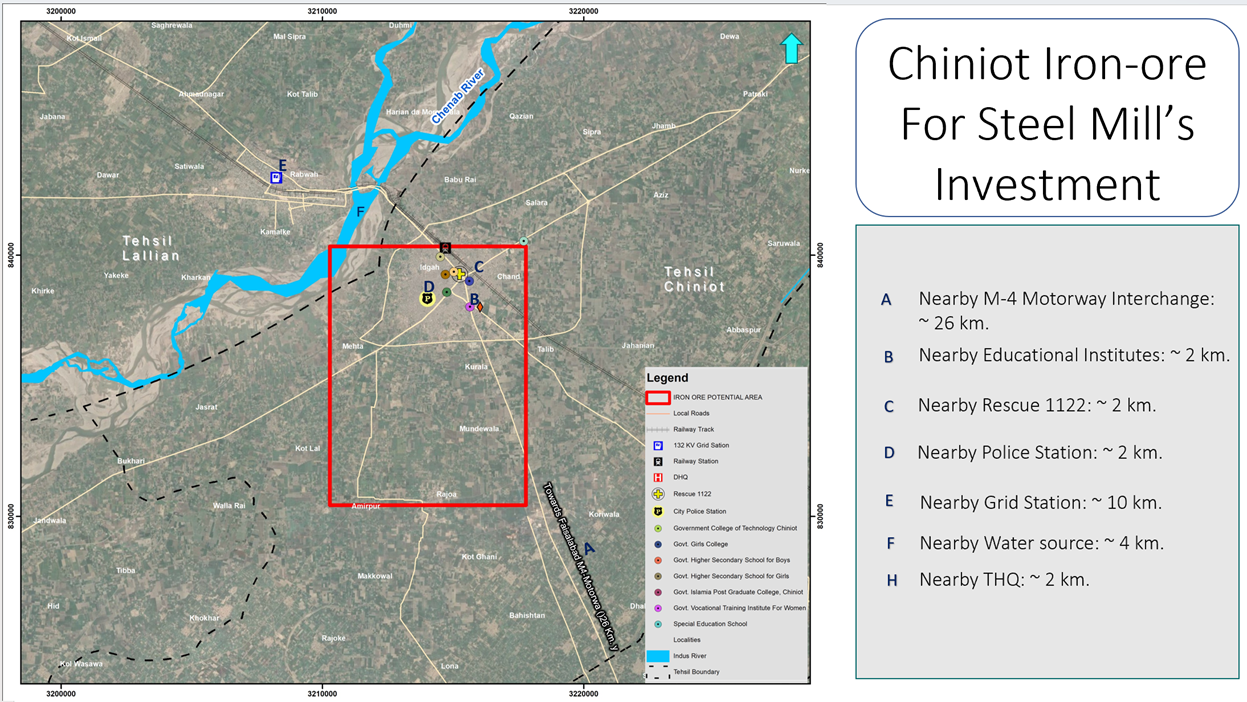
Location: Southern edge of Chiniot town, 35 km north of Faisalabad |
| Coordinates: 309129 E, 3510426 N |
|
Deposit dimensions: ~1.54 km length × 0.8 km width |
| Mineralisation type: IOCG (Hematite, Magnetite, Copper) |
◆ Exploration Completed (to international standards)
| 87 boreholes • 73,451 m drilled |
|
27,260 core samples • 26,976 assays completed (99%) |
| Supporting studies: petrography, XRD, geotech, hydrogeology |
Business Case Snapshot (prepared by DMT Consortium – Germany/UK/Pakistan)
| Component |
Capex (US$ million) |
| Mining |
154 |
| Ore Processing |
189 |
| Steel Mills |
930 |
| Total |
1,273 |
| IRR > 20% |
|
Payback ~9 years |
| Project life > 40 years |
|
Output: Hot-rolled coil steel (import substitution) |
◆ Key Strengths
- No local competing resource of similar scale
- Adjacent to M-4 Motorway (~26 km), rail network, FIEDMC Special Economic Zone and Faisalabad International Airport
- DRI-grade fines/pellets possible
- Full hydro & geotech studies already completed
Location map with infrastructure radii (schools, rescue, grid, water, THQ all within 2–10 km)
◆ Iron Ore – Kalabagh
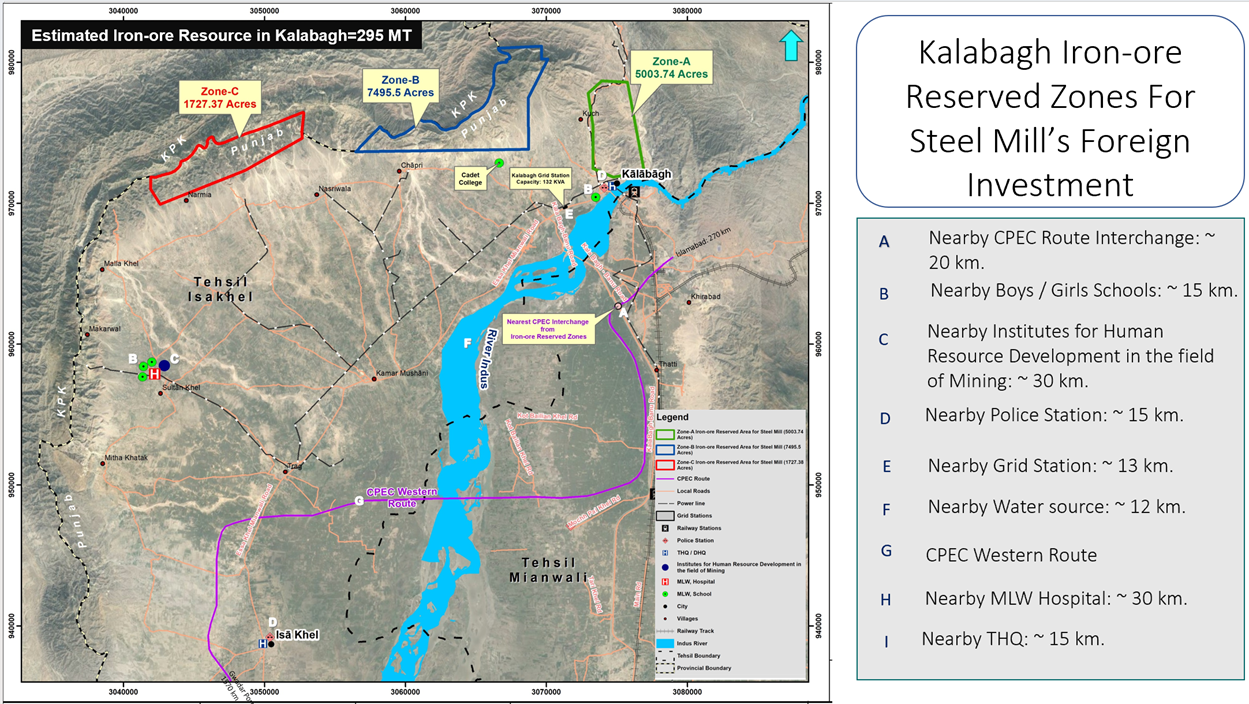
Kalabagh offers another major iron-ore opportunity for steel-mill investment, with substantial reserved zones and excellent connectivity to the CPEC corridor.
◆ Resource Highlights
| Estimated iron-ore resource: 295 million tonnes |
|
Reserved zones specifically earmarked for steel-mill foreign investment |
◆ Location Advantages
- ~20 km from CPEC Western Route interchange
- 270 km from Islamabad
- Gwadar Port ~1,570 km
- Nearby schools (~15 km), mining training institutes (~30 km), police (~15 km), grid station (~13 km), water sources (~12 km), hospitals and THQ (~15–30 km)
◆ Rock Salt – Himalayan Pink Salt
Punjab’s Himalayan Pink Salt is internationally recognised for its purity and health benefits. Premium pricing in edible-salt markets and strong industrial demand make it a high-value investment opportunity.
◆ Health & Market Advantages
| Improves respiratory health |
|
Reduces signs of ageing |
| Balances body pH |
|
Improves sleep quality and helps regulate blood sugar |
Industrial & Commercial Uses
Soda ash • Caustic soda • Sodium sulphate • Hydrochloric acid • Edible salt • Decorative articles • Dyes • Fumigation • Ore refining • Pigments • Road de-icing
◆ Current Status & Opportunity
| 39 mining leases already granted |
|
34 exploration licences issued for large-scale industrial undertakings |
| 4 soda-ash plants operational; further industrial units under development |
|
29,980 acres across 27 blocks marked for competitive bidding |
| Additional 56 areas currently under scrutiny for future auctions |
Location Advantages
Motorway interchanges 10–20 km • Schools, mining institutes, police stations, grid stations, water sources and hospitals within 5–30 km.
◆ Limestone – Cement Plants & Chemical Industry
Punjab holds abundant high-quality limestone reserves in the Salt Range and Suleman Range, ideal for cement manufacturing and chemical industries. Thick cap-rock deposits (200–300 m) combined with readily available clay, gypsum and laterite create a complete raw-material package for new cement plants.
◆ Key Facts
| Salt Range extends ~200 km with limestone thickness of 200–300 m. |
|
14 cement plants already operational in Punjab. |
| Major cost structure of cement production in Punjab: Fuel 46%, Power 17%, Others 23%, Packaging 8%, Raw Material 6%. Energy (fuel + power) accounts for ~63% of total production cost. |
| 1 tonne of clinker requires ~4.6 million Btu (~160 kg bituminous coal). |